
Applying Structural Discipline to Your First Betting Bankroll
My first ever horse racing bet was a 20-pound accumulator on four horses I picked because I liked their names. I lost the lot before the second race had even started. That was an expensive lesson in what not to do — and looking back, it’s the same mistake roughly 15% of UK adults who bet on racing at least monthly are making in some form. They jump in without understanding the basics, burn through their budget, and decide the game is rigged.
It isn’t rigged. It’s just complex enough to punish the unprepared and reward anyone willing to learn a handful of fundamentals before placing their first serious bet. I’ve spent eight years analysing UK racing data, and the single biggest difference between bettors who stick around and those who quit in frustration isn’t talent or luck — it’s preparation.
This guide covers the essentials you need before placing your first 10 bets. Not systems, not advanced strategies, not tipster subscriptions. Just the practical knowledge that stops you losing money for the wrong reasons.
Once you are comfortable with single win bets, you can explore higher-yielding approaches like a structured horse racing exacta strategy to boost your payouts.
Essential Bet Types: Win, Place, Each-Way, and Nothing Else for Now
Walk into any betting shop or open any online account and you’ll find dozens of bet types: exactas, trifectas, accumulators, Lucky 15s, patent bets, forecasts, Placepots. Ignore all of them for now.
Start with three bet types and nothing else. A win bet is the simplest wager in racing — you pick a horse, it wins, you get paid. It loses, you lose your stake. No complications. A place bet pays out if your horse finishes in the top two, three, or four depending on the number of runners and the race type. The returns are smaller but the probability of collecting is higher. An each-way bet combines both: half your stake goes on the win, half on the place. If the horse wins, you collect both parts. If it places but doesn’t win, you collect the place part and lose the win part.
Each-way betting is the workhorse of UK racing. It’s where most casual punters start and where many professionals still operate. But it’s also where beginners lose money without realising it, because the place terms — the fraction of win odds paid for a place — vary by race size and type. In races with 5-7 runners, places pay at one quarter of the win odds for the first two positions. In races with 8-15 runners, it’s one quarter odds for the first three. Handicaps with 16 or more runners pay one quarter odds for the first four.
My advice for your first ten bets: stick to win bets on races with 8 or more runners. You’ll learn to evaluate form without the added complexity of place-term calculations, and you’ll see clearly whether your selections are competitive.
Reading the Race Card: The Five Things That Matter Most
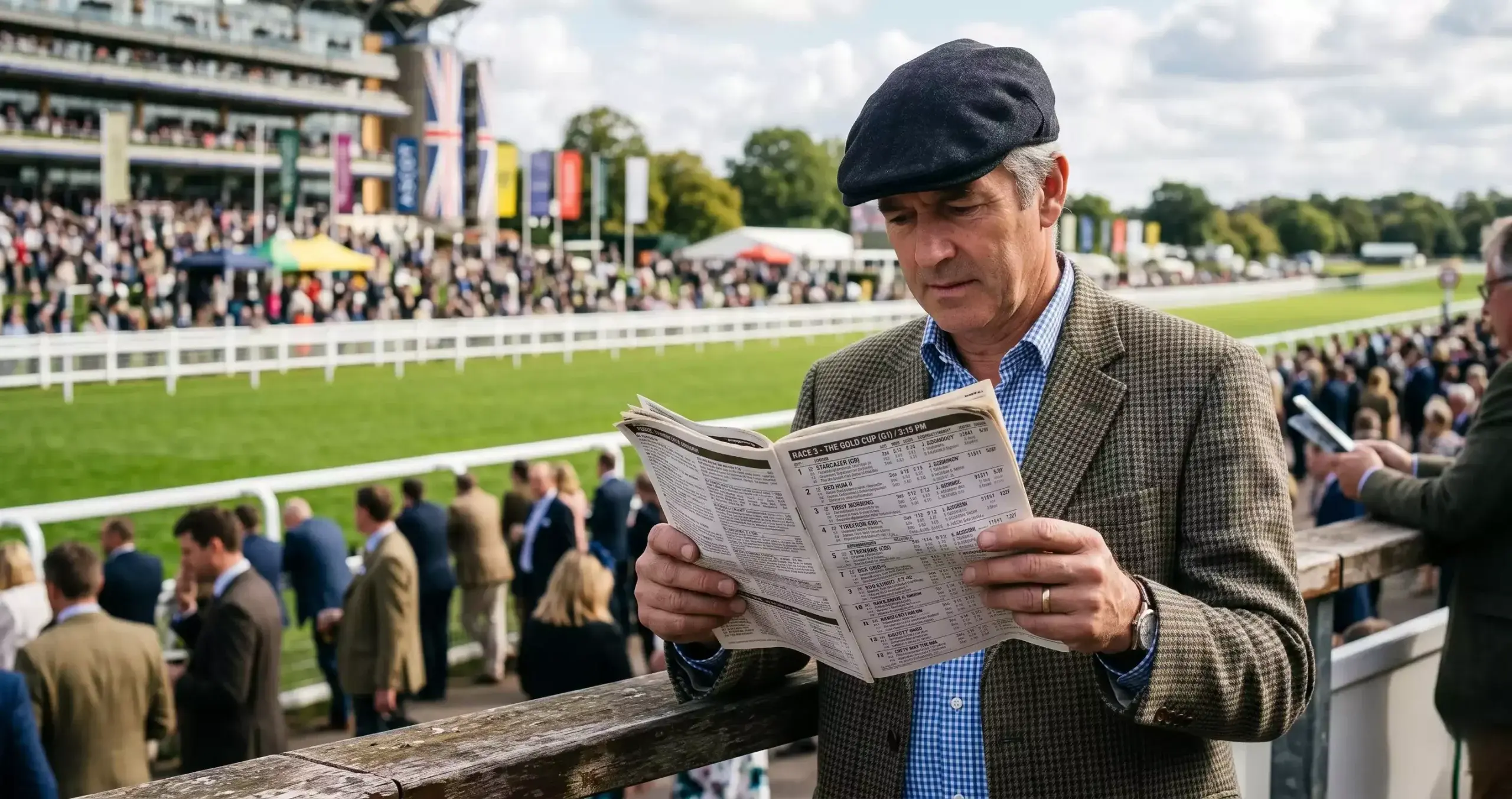
A race card looks intimidating the first time you see one. Columns of numbers, abbreviations, symbols — it’s like reading a spreadsheet in a foreign language. But you don’t need to understand everything on day one. Five elements carry the vast majority of the information that matters.
Recent form figures. These are the numbers next to each horse’s name, reading left to right from oldest to most recent. A “1” means a win, “2” means second place, and so on up to “0” for tenth or worse. A forward slash (/) indicates a break between seasons. Look for horses with recent form figures of 1, 2, or 3 — they’ve been competitive in their last few starts. A string of 0s and high numbers means the horse has been well beaten repeatedly.
Distance. Every horse has an optimal distance range. A race card shows whether this race suits. Look for horses who have won or placed over today’s distance or within half a furlong of it. A sprinter entered in a mile-and-a-half race is there to make up the numbers.
Going. The ground condition — firm, good, soft, heavy — affects every horse differently. The race card typically shows each horse’s record on today’s going. A horse with a form figure of “1” on soft ground who’s racing on heavy ground is far more interesting than one with the same figure achieved only on firm.
Class. Races are graded by class, from Class 1 (the highest, including Group races) down to Class 7. A horse dropping in class from the race before is potentially well-placed. One stepping up sharply from Class 5 to Class 2 is probably out of its depth. Favourites in UK racing win about 34.4% of all races, but that figure rises significantly in non-handicaps where class differences are more pronounced — roughly 39%.
Trainer form. Is the trainer’s yard sending out winners? A trainer with five winners from their last twenty runners is in form. One with zero from thirty is either struggling or sending out horses for experience. Recent trainer form, measured over 14 or 30 days, is one of the most underused pieces of publicly available information in form analysis.
Build a solid foundation for your punting career by following the core principles outlined on the horseracingbetguide.com homepage.
10 Practical Tips for Your First Day at the Races
Set a budget before you leave the house. Decide exactly how much you’re willing to lose — because that’s what a first day at the races usually costs. Fifty pounds is plenty for six or seven races. That gives you roughly seven or eight pounds per bet.
Don’t bet every race. There are usually six or seven races on a card. You don’t need to bet on all of them. I’d suggest picking three or four where you’ve had time to study the form, and sitting out the rest. Watching a race without money on it teaches you to read pace, positioning and how the track plays without the emotional noise of having skin in the game.
Back horses, not names or colours. It sounds obvious, but the number of people who back a horse because it shares a name with their dog, or because the jockey wears their favourite colour, is astonishing. Form matters. Names don’t.
Check the going report. The going is announced on the morning of racing and can change throughout the day. If it’s rained overnight and the going has shifted from “good” to “soft”, every selection you made the night before needs re-evaluating. Horses with proven soft-ground form just became more interesting; those with only fast-ground credentials just became liabilities.
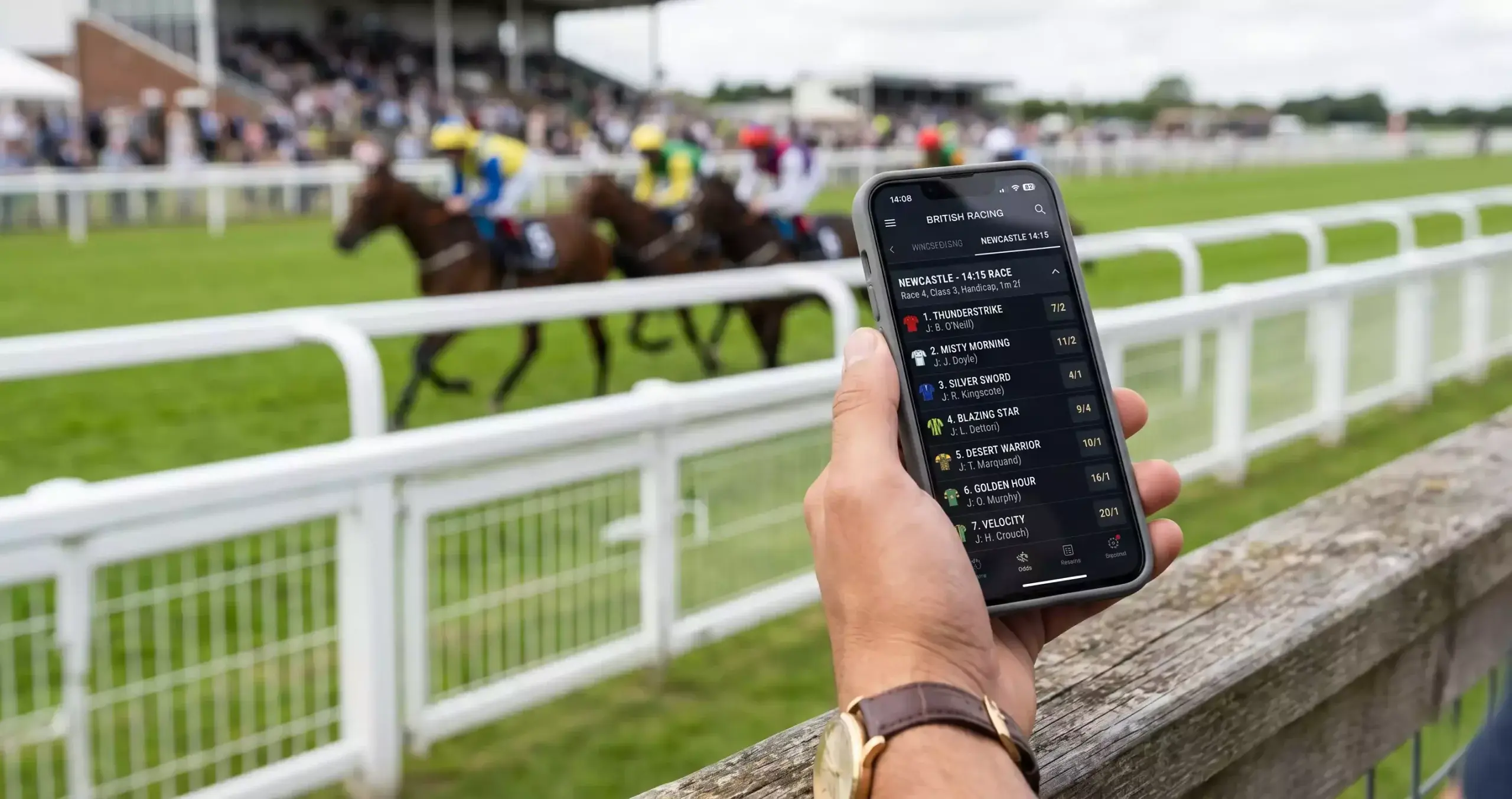
Use the morning odds as a benchmark. Odds published in the morning are the bookmaker’s opening assessment. By the time the race starts, money from punters and professional gamblers will have moved those prices. A horse whose odds shorten from 10/1 in the morning to 6/1 at the off is attracting serious support. One that drifts from 5/1 to 12/1 is being avoided. Market movements aren’t infallible, but they reflect information flow.
Avoid accumulators. The temptation to string four or five selections into an accumulator for a big payday is strong. Resist it. Accumulators compound the bookmaker’s overround across every leg. A four-fold at 15% overround per leg gives the bookmaker a massive compounded edge. Singles are how you learn, and how most profitable bettors actually operate.
Write down why you’re backing each horse. Before every bet, write a single sentence explaining your reasoning. “Dropping in class, won on this ground last time, trainer in good form.” If you can’t articulate a reason, you don’t have one — and you shouldn’t be betting.
Don’t chase losses. You backed two losers and now you’re thinking about doubling your stake on the next race to recoup. This is the fastest way to empty your budget. Treat each bet as independent. The previous result has no bearing on the next one.
Compare odds across at least two bookmakers. If you’re betting online, spend thirty seconds checking whether another bookmaker offers a better price. A difference of half a point in the odds — 9/2 instead of 4/1 — adds up significantly over time. Best Odds Guaranteed promotions at major UK bookmakers mean you’ll always get the higher of your bet price and the starting price, which is effectively free insurance.
Review your bets at the end of the day. When you get home, look at every bet you placed. Did your reasoning hold up? Did the horse you backed run the race you expected, even if it didn’t win? A horse that ran well but got beaten by a better one is a better sign than one that won because the favourite fell. The review is where learning actually happens.