
Interpreting Trainer Statistics and Form Guide Metrics
Early in my career, I backed a horse at Cheltenham based entirely on its price. The bookmaker offered 12/1, the exchange had it at 10.0, and I thought I’d found a value gap. The horse finished last, beaten 40 lengths, and a five-minute look at the form would have told me why: it hadn’t finished closer than 15 lengths in four runs, was dropping back to a trip it had never won at, and its trainer’s strike rate at the course was 2% from 60 runners. I hadn’t been value betting. I’d been gambling blind with a calculator.
Form analysis is what turns a price on a screen into a meaningful assessment of a horse’s chances. Without it, your probability estimates — and therefore your expected value calculations — are built on nothing. Professional bettors who maintain that narrow 52-55% accuracy rate in their selections don’t achieve it through intuition or inside knowledge. They achieve it through systematic, repeatable analysis of publicly available data. The race card, speed figures, trainer records, going preferences, and course characteristics aren’t secret weapons — they’re open-book exams. The edge comes from reading the book more carefully than the market.
The number of horses in training across Britain dropped to 21,728 in 2025, continuing a multi-year decline. Fewer horses means more repeat runners, more data on each horse, and — in theory — more efficient markets. That efficiency makes form analysis both harder and more important: you need to dig deeper to find the angles that the market has missed, but the data available to do that digging has never been more accessible.
This guide walks through the full form analysis toolkit: race cards, speed figures, going data, trainer and jockey statistics, and course-specific factors. The goal isn’t to memorise a checklist but to build a process you can repeat for every race, generating probability estimates that are consistently more accurate than the odds suggest.
Even the best speed figures can be misleading if you fail to account for the day’s specific horse racing going conditions and how they impact stamina.
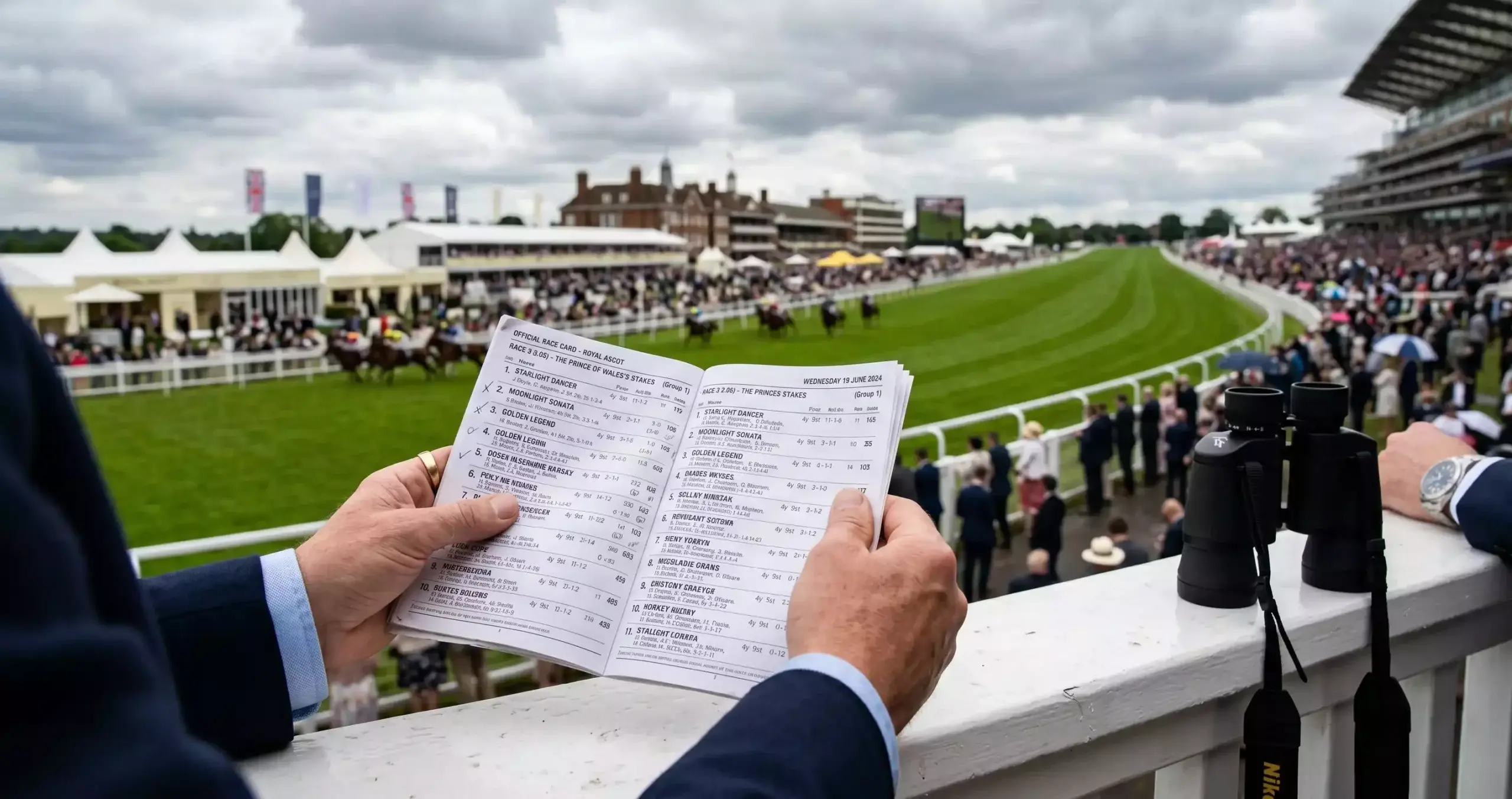
Reading the Race Card: Every Symbol and Column Explained
A race card looks like an encrypted spreadsheet the first time you see one. Numbers, letters, symbols, colours — none of it obvious, all of it meaningful. I remember staring at my first card and wondering who decided that “1213-1” was a reasonable way to communicate anything. But once you crack the code, every character tells you something about a horse’s recent history, and reading a card becomes as automatic as reading a scoreline.
The form figures are the backbone. They appear as a string of numbers and letters to the left of the horse’s name, reading right to left from the most recent run. “1” means first place, “2” second, and so on up to “0” for tenth or worse. A dash separates different seasons. Letters carry specific meanings: “F” for fell, “U” for unseated rider, “P” for pulled up, “R” for refused, “B” for brought down, “C” for carried out. So “2131-F2” tells you the horse finished second last time out, fell the time before that, won three starts ago, finished third before that, won the run before that, and finished second in its last run of the previous season.
Beyond form figures, the card gives you the horse’s age, weight carried, draw position (in flat races), the trainer and jockey, the number of days since last run, official rating, and equipment indicators like blinkers or tongue tie. Each column matters, but not equally for every race. Draw is critical at Chester, irrelevant at Cheltenham. Days since last run matters enormously for older jumps horses, less so for three-year-olds on the flat.
Weight carried is listed in stones and pounds. In a handicap, the weight is assigned by the official handicapper based on the horse’s rating — higher-rated horses carry more weight to level the field. A horse set to carry 9st 7lb against one carrying 8st 4lb is considered the superior animal by 17 pounds, roughly equivalent to four or five lengths at most trips. Understanding this relationship between weight and performance is fundamental to handicap assessment. A horse that ran well under 8st 10lb might struggle under 9st 5lb if the handicapper has raised its mark after a good run — and the form figures alone won’t tell you that.
Official ratings deserve special attention. A horse rated 85 running in a Class 4 handicap (typically rated 0-80) is running off top weight and facing horses theoretically below its ability. That sounds advantageous, but the extra weight it carries can negate the class edge. Conversely, a horse rated 68 in the same race carries less weight and may be well-handicapped if it’s recently improved. The interplay between rating, weight, and class is where race card analysis gets genuinely interesting — and where most casual bettors stop reading.
I spend about two minutes per horse on the race card alone, jotting down initial impressions: recent form trajectory (improving, declining, or consistent), weight changes from last run, jockey booking significance, and any equipment changes. This gives me a quick shortlist of three or four contenders before I move to the deeper analysis that follows.
Speed Figures: Timeform, RPR, and Sectional Timing Decoded
Form figures tell you where a horse finished. Speed figures tell you how fast it ran to get there. The distinction matters more than most punters realise — a horse that won by three lengths in a slowly-run tactical race may have posted a weaker performance than one that finished third in a genuinely fast-run contest. Speed figures strip away the visual impression and give you a standardised number that allows direct comparison across different races, courses, and conditions.
Three speed figure systems dominate UK racing. Timeform ratings are the oldest and most respected — they rate every performance on a pounds-per-length basis, where a higher number means a faster-adjusted time. A Timeform figure of 110 represents a significantly better performance than one rated 95, regardless of the finishing position. Racing Post Ratings (RPR) work on a similar scale and are freely available with a Racing Post subscription. Both adjust for wind, going, weight carried, and race pace, which means you’re comparing like with like.
Sectional timing is the newer and — in my experience — more powerful tool. Traditional speed figures measure the overall race time; sectionals break the race into segments, typically the final two or three furlongs. This matters because a horse that covered the last three furlongs of a mile race in 35 seconds has demonstrably more finishing speed than one that clocked 37 seconds, even if the latter won by a wider margin thanks to a slower early pace. Average field sizes on the flat dropped to 8.90 in 2025, down from 9.14 the year before, which means fewer race replays to study — but sectional data captures the performance nuances that video alone cannot.
I use speed figures as a second filter after the race card. Once I’ve identified my shortlist of contenders based on form, I pull their best speed figures from the last three relevant runs. “Relevant” means on similar going — a speed figure posted on firm ground is largely meaningless if tomorrow’s race is on soft. I’m looking for horses whose best recent figure is either the highest in the field or within two or three pounds of the highest, because these are the horses with proven ability at the level required.
The trap to avoid is anchoring on a single outstanding figure. A horse that posted a 112 Timeform rating once but typically runs in the 95-100 range is a 95-100 horse that had one exceptional day, not a 112 horse having a series of bad runs. I weight the median of the last three relevant figures more heavily than the peak, because the median is a better predictor of what the horse will produce next time.
Premier fixtures — the big-meeting days — saw average betting turnover per race rise by 2.7% in 2025 even as Core fixtures declined by 8.6%. This polarisation means the market is sharpest at the top level, where more money and more analysts scrutinise every runner. Speed figures become more important as the market gets more efficient, because they’re the closest thing to an objective measure of ability that doesn’t rely on opinion.
Going Conditions: How Ground Affects Performance
I once backed a horse at 5/2 that had won its last three starts impressively. The form was obvious, the price was short, and the market clearly agreed. It finished sixth of seven, never travelling with any fluency. The difference? Its three wins had come on good-to-firm ground. Race day was soft after overnight rain. That horse couldn’t handle the slower surface, and anyone who’d checked its going record — a 30-second task — would have known it.
Going conditions in the UK run on a scale from firm (the fastest, driest surface) through good-to-firm, good, good-to-soft, soft, to heavy (the slowest, most demanding ground). Jump racing adds a further distinction with “yielding” in Irish races, roughly equivalent to good-to-soft. Each category transforms the nature of a race: a mile on firm ground might take 1 minute 36 seconds; the same mile on heavy could take 1 minute 48 seconds. Horses bred for speed on fast surfaces often struggle on ground that demands stamina and knee action.
The going is measured using a penetrometer — a mechanical device pushed into the turf to gauge resistance — and reported by the clerk of the course on the morning of racing, often with updates throughout the day. It’s not a precise science: “good-to-soft, soft in places” tells you the ground varies across the track, and the places that are softest (typically the rail and lower-lying sections) will affect horses drawn there disproportionately.
I classify every horse into one of four going preference categories based on their form: fast-ground specialist, versatile, soft-ground specialist, or unknown. A horse that has won on firm and good-to-firm but has never run on soft is a fast-ground specialist until proven otherwise — and I won’t bet on it when the ground has significant cut. The reverse applies: soft-ground specialists running on firm often appear to lose their action, running flat and one-paced because the surface doesn’t suit their stride pattern.
Going preferences interact with everything else in the form analysis. Speed figures need adjusting for the surface — a 105 on heavy is a stronger performance than a 105 on firm, because heavy ground naturally slows times and reduces the scoring scale. Trainer data should be filtered by going: some trainers excel at placing their soft-ground horses at exactly the right meeting, producing a strike rate above 20% on heavy when their overall figure sits at 12%. These details don’t appear in headline statistics, and finding them requires a level of digging that most punters skip.
Trainer and Jockey Statistics: Patterns Worth Tracking
Richard Wayman, the BHA’s Director of Racing, acknowledged in the 2025 Racing Report that “there are challenges with the horse population continuing to decline and the betting environment remaining a challenging one.” When the pool of horses shrinks — 21,728 in training in 2025, down 2.3% — the trainers who maintain quality strings become even more important. Their runners represent a disproportionate share of competitive entries, and their patterns become both more visible and more exploitable.
Trainer form runs in cycles. A stable that’s firing on all cylinders — good weather, healthy horses, peak fitness in the string — can produce a 25-30% strike rate for weeks. The same stable during a quiet patch might drop to 5%. I track 14-day and 30-day trainer form as rolling indicators, not because past performance guarantees future results (it doesn’t), but because a trainer in form is managing their horses well, timing their entries wisely, and — crucially — their horses are healthy. A sudden decline in a previously in-form trainer’s results is a stronger signal to avoid their runners than any individual piece of form data.
Jockey bookings carry information that isn’t always obvious from the form. When a trainer replaces a claiming jockey with a top-tier rider for a midweek handicap at Kempton, they’re signalling confidence — and paying a premium in jockey fees that only makes sense if they believe the horse has a genuine chance. Conversely, when a horse that was ridden by a stable’s number-one jockey last time out is now booked with a 5-pound claimer, that’s often a sign the connections don’t fancy its chances and are using the weight allowance as a consolation rather than a tactic.
I pay particular attention to jockey-trainer combinations with a proven record. Some partnerships produce results that exceed either party’s individual statistics — a trainer with a 14% overall strike rate and a jockey with 16% might combine for 22% when they work together. These partnerships often reflect a specific understanding: the jockey knows the trainer’s methods, knows the horse’s quirks, and rides them accordingly. Data on these combinations is publicly available through Racing Post and Timeform, and filtering for combinations with 20+ runs and an above-average strike rate will produce a useful shortlist of connections worth following.
One caveat: draw bias at specific courses can override even the best jockey booking. A champion jockey drawn one at Chester over seven furlongs faces a structural disadvantage that skill alone cannot overcome. Trainer and jockey data is powerful, but it operates within the physical constraints of the racecourse, and the next section addresses exactly those constraints.
Access our complete library of analytical tools by visiting the premier UK horse racing betting guide.
Course Specifics: Track Configuration, Draw Bias, and Field Size
Not all racecourses are created equal, and a horse’s form at one track can be misleading when it switches to another with different characteristics. UK racecourses vary enormously in configuration — left-handed, right-handed, straight, undulating, sharp, galloping — and each layout rewards different types of horse.
A galloping track like Newmarket’s Rowley Mile rewards long-striding horses with stamina, because the wide, straight layout allows them to sustain their action. A sharp, turning track like Chester — essentially an oval barely a mile around — favours handy, quick-turning horses that can maintain momentum through tight bends. A horse with a perfect record at Newmarket might flounder at Chester, and vice versa. Course form — how a horse has performed at a specific track — is one of the most reliable predictive factors I use, particularly for horses with five or more runs at a venue.
Draw bias is a flat-racing phenomenon that can dramatically affect the outcome at certain courses. At Chester, low draws (stalls nearest the inside rail) have a significant advantage at distances of seven furlongs and beyond because they travel the shortest route around the tight circuit. At Beverley, high draws tend to have the edge over five furlongs. These biases aren’t consistent — they shift with the going (softer ground can neutralise a draw advantage by forcing horses wider) and with the rail position (which side of the track the running rail is placed on). But at courses with known strong biases, ignoring the draw is like ignoring the going: a fundamental analytical error.
Field size interacts with course shape in ways that matter for both form analysis and betting strategy. Larger fields at tight tracks create traffic problems — horses get boxed in, forced wide, or denied a clear run. A horse that finished fifth in a 16-runner race at a sharp track may have run a better race than the bare result suggests if it was trapped behind a wall of horses for the final two furlongs. Race replays are essential here. The form figures say “fifth”; the replay shows the horse was travelling best of all with nowhere to go.
I maintain a personal database of course notes — nothing elaborate, just a spreadsheet with observations about track bias, typical pace scenarios, and which running styles are favoured at each course and distance. After a few seasons, these notes become a form analysis shortcut: before I dive into the race card, I check my course notes to understand what type of horse the track rewards, and that framing guides everything that follows.
Putting It All Together: A Form Analysis Workflow
All the individual elements I’ve described — race cards, speed figures, going data, trainer stats, course characteristics — are useless in isolation. They need to be combined into a workflow that you can run consistently for every race, producing a probability estimate that feeds directly into your value assessment.
My workflow runs in five stages, and the order matters. First, I check the course and going to establish the physical context — what type of horse does this track and surface favour today? Second, I read the race card for every runner, identifying form trajectory, weight changes, and jockey bookings. Third, I pull speed figures for my shortlisted horses and compare them against the field. Fourth, I check trainer and jockey data — form cycles, course records, and combination statistics. Fifth, I assign a probability to each runner, ensuring the total across the field sums to 100%.
That fifth stage is where the magic — and the difficulty — lives. Assigning probabilities forces you to rank every horse, including the ones you’d normally ignore. It also forces internal consistency: if you give horse A a 25% chance and horse B a 20% chance, you’re saying A is more likely to win than B. Is that really what your analysis concluded? Sometimes the act of quantifying makes you reconsider — and that reconsideration often improves the final estimate.
Academic research has demonstrated that unraced two-year-olds running for the first time carry hidden information — their probability of winning is roughly 16% higher than that of similarly-priced horses with exposed form, suggesting insiders know more about debutants than the public. That finding reminds me that form analysis has limits. For horses with no public form, market signals — the price, the stable, the connections — become your only data points, and they carry weight precisely because the information asymmetry is greatest with unraced runners.
The whole process takes me about 15 minutes per race for a standard handicap, less for smaller fields. On a Saturday with six races at a Premier meeting, that’s 90 minutes of focused analysis before a single bet is placed. It’s a time investment that pays for itself many times over — not because it guarantees winners, but because it produces probability estimates that are systematically more accurate than the casual approach of glancing at the form and backing the horse with the best recent result. Accuracy in estimation is the foundation of everything I’ve built as a bettor. Form analysis is how I build that accuracy, one race at a time.