
Building a Sustainable Edge Through Expected Value Metrics
I spent my first two years betting on horse racing trying to pick winners. I was reasonably good at it — my strike rate hovered around 30% on the flat — and I still lost money. Every month, the bankroll shrank. Not dramatically, not in one catastrophic afternoon, but in that slow, grinding way that makes you question whether you’re doing something fundamentally wrong.
I was. The mistake wasn’t in my selections. It was in my understanding of what “profitable” actually means. I was backing horses that won often enough but at prices that didn’t compensate for the losers in between. I was picking winners, not finding value — and those are two entirely different skills.
Only 2-3% of sports bettors turn a long-term profit. The professionals among that tiny group don’t predict the future better than anyone else — they typically get the winner right in just 52-55% of their bets. What separates them is discipline around one concept: expected value. They refuse to bet unless the odds offered are higher than the odds they believe reflect the true probability of a horse winning. Everything else — form analysis, speed figures, trainer data — feeds into that single calculation.
Value betting isn’t a strategy you bolt onto your existing approach. It’s a complete reorientation of how you think about every wager you place. Instead of asking “will this horse win?” you learn to ask “are these odds too generous for this horse’s actual chances?” That shift took me from slow-bleed losses to consistent, measurable returns over eight years of UK racing data. This guide walks through exactly how to make it — formula, method, and the practical traps that catch people along the way.
Implied Probability: Converting Odds Into Percentages
Before you can spot a value bet, you need to speak the language bookmakers use to price a race — and that language is implied probability. Every set of odds, whether fractional or decimal, carries a hidden message: “We think this horse has roughly X% chance of winning.” Your job is to decode that message, compare it with your own assessment, and act when the numbers disagree.
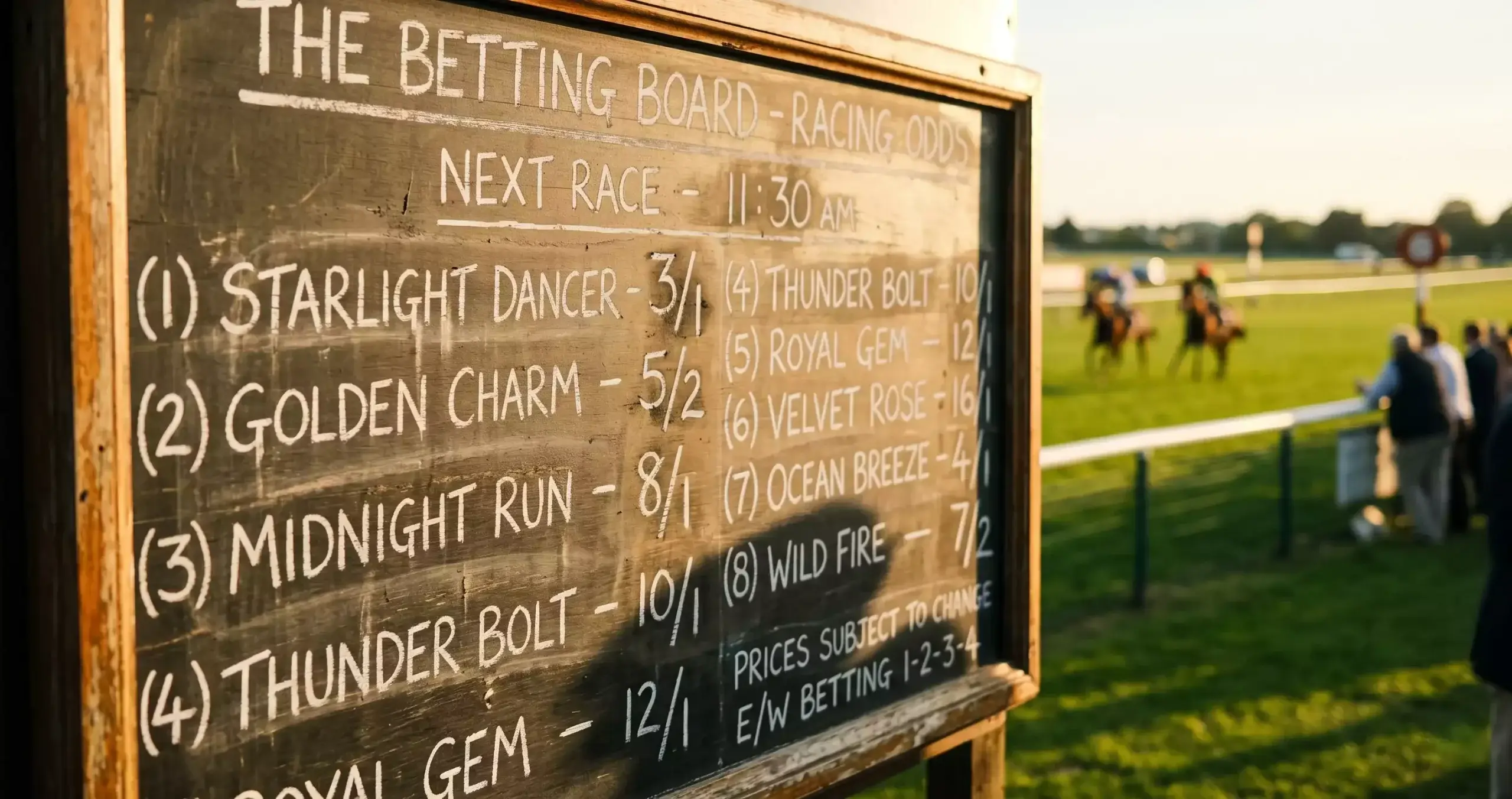
The conversion is straightforward. For decimal odds, divide 1 by the decimal price and multiply by 100. A horse at 4.00 (3/1 in fractional) implies a 25% chance of winning: 1 / 4.00 = 0.25, or 25%. A horse at 2.50 (6/4) implies 40%. A horse at 1.50 (1/2) implies 66.7%. For fractional odds, the formula is denominator / (numerator + denominator) x 100 — so 3/1 gives you 1 / (3+1) = 25%.
Here’s where it gets interesting. If you add up the implied probabilities of every runner in a race, the total should be 100% — but it never is. In a typical UK race, the total comes to 115-125%. That surplus is the bookmaker’s overround, essentially a built-in margin that guarantees them profit regardless of which horse wins. A race with six runners priced at 3/1, 4/1, 5/1, 6/1, 8/1, and 10/1 carries implied probabilities of 25%, 20%, 16.7%, 14.3%, 11.1%, and 9.1% respectively — totalling 96.2% before the overround inflates each price downward.
The overround tells you something vital: every horse in the book is priced at slightly worse odds than its “true” probability warrants. Your edge comes from finding horses where the gap between the bookmaker’s implied probability and your estimated true probability is wide enough to overcome that margin. Understanding this relationship is the foundation of everything that follows. Without it, you’re navigating blind.
I keep a quick-reference table taped to the side of my monitor with the most common fractional odds and their implied probabilities. After a while, the conversions become second nature — you see 9/2 and your brain instantly registers “18.2% implied” without reaching for a calculator. That fluency matters, because the best value bets disappear fast, particularly in the morning markets when prices are still soft.
The Expected Value Formula: A Step-by-Step Calculation
A punter I respected once told me: “If you can’t put a number on your edge, you don’t have one.” He was talking about expected value — the single calculation that separates gambling from investing. EV tells you how much you’ll win or lose per pound staked, on average, if you could place the same bet thousands of times.
The formula: EV = (Probability of Winning x Net Profit per Win) – (Probability of Losing x Stake Lost). Let me walk through a real example.
You’ve studied a handicap at Newbury and you believe a horse has a 30% chance of winning. The bookmaker offers 4/1 (decimal 5.00), which implies only a 20% chance. Your stake is 10 pounds. The calculation runs like this: EV = (0.30 x 40) – (0.70 x 10) = 12 – 7 = +5. On a 10-pound stake, your expected value is +5 pounds. That’s a 50% return on investment per bet — exceptional value that you’d take every single time.
Now let’s flip it. Same horse, same 30% estimated probability, but the bookmaker offers 2/1 (decimal 3.00), implying 33.3%. Your EV becomes: (0.30 x 20) – (0.70 x 10) = 6 – 7 = -1. Negative EV. You believe the horse has a genuine chance, you might even think it’ll win — but the odds don’t compensate you enough for the times it loses. This is the bet most punters would still take, because the horse “looks good.” And this is exactly why most punters lose.
The uncomfortable truth is that a +EV bet loses more often than it wins when you’re backing horses at longer prices. A horse with a true 25% chance of winning at 5/1 offers superb value, but it loses three out of four times. Your brain screams that you’re doing something wrong during the inevitable losing runs. The maths says otherwise — and trusting the maths over your instincts is the hardest part of value betting.
The typical bookmaker overround on UK horse racing sits between 15-20% for standard races, sometimes climbing above 25% at smaller meetings. That overround has been declining historically — from peaks around 28% in 2001 to roughly 20% by 2022 — which is good news for value bettors, because a thinner margin means less ground to make up. But even at 15%, you need to be consistently better than the market at estimating true probabilities to generate a positive expected value. That’s the skill. The formula just quantifies it.
I calculate EV on every bet I place, without exception. It takes about thirty seconds with a calculator. On days when I can’t find a single +EV opportunity across the entire card, I don’t bet. That discipline alone — the willingness to sit on your hands — will improve your results more than any tip sheet or system.
How to Estimate True Odds for a Horse
Here’s the part that makes people uncomfortable: nobody knows the true odds of a horse winning. Not you, not the bookmaker, not the trainer saddling the horse. True probability is an estimate, always. The question isn’t whether your estimate is perfect — it’s whether your method of estimation is systematic enough to be right more often than the market.
I use three approaches in combination, weighting each differently depending on the race type.
The first is form-based probability. I work through the race card — recent results, speed figures, going preferences, trainer form, course record — and assign each contender a rough probability. This isn’t a precise science. For a 12-runner handicap, I might conclude that three horses have a genuine 15-20% chance, four sit at 8-12%, and the rest are in the 2-5% range. Those numbers should total 100%. If they total 130%, I’m overrating the field. If they total 70%, I’ve been too harsh. Adjusting until the numbers balance forces disciplined thinking about every runner, not just the ones you fancy.
The second is market-derived probability with overround removal. Take the bookmaker’s odds, convert them to implied probabilities, add them up to find the total overround, then normalise each runner’s implied probability to total 100%. If a horse is priced at 4/1 (20% implied) in a market with 120% overround, its normalised probability is 20 / 120 = 16.7%. This gives you the market’s “true” opinion stripped of margin. It’s useful as a baseline — not because the market is always right, but because it aggregates thousands of opinions and usually falls within a few percentage points of reality.
The third draws on base-rate data. Favourites in UK racing win about 34.4% of all races. In handicaps, that drops to roughly 25.7%, while in non-handicaps it climbs to around 39%. These base rates act as sanity checks. If your form analysis concludes a handicap favourite has a 50% chance of winning, you’re almost certainly overrating it — the entire historical record argues against any handicap favourite winning that often. Conversely, if you’ve identified a non-handicap favourite with strong course form, solid speed figures, and a top trainer on a winning streak, a 45% estimate is perfectly reasonable given the base rates.
The interplay between these three methods is where the edge lives. When my form analysis says 25%, the market implies 20%, and the base rates support the 25% range — I have a value bet. When my form analysis says 25% but the market implies 30%, I step back and ask what the market sees that I’m missing. Sometimes the answer is nothing, and the market has overreacted to a big name or a flashy last win. More often, there’s a factor I’ve underweighted — a change of ground, a step up in class, a jockey booking that signals connections’ lack of confidence.
This triangulation takes practice. My estimates in year one were awful. By year three, they were consistently within 5% of the market on most runners and occasionally catching genuine mispricing on others. That’s all it takes — you don’t need to outsmart the market on every horse, just on enough of them to generate a stream of +EV bets.
Practical Methods for Spotting Value in UK Markets
Theory is comfortable. Practice is where the bruises come from. Let me walk through how I actually identify value bets on a typical Saturday card — the process I’ve refined over eight years of UK racing.
My morning starts at around 8am with the overnight declarations. I pull up the race cards for every meeting and immediately filter by race type. Non-handicap races with small fields — five or six runners — rarely throw up value because the market prices them efficiently. The bookmakers get these right more often than not. Large-field handicaps at 10+ runners are where mispricing hides, because the complexity of assessing 15 or 20 horses creates gaps in the market’s collective knowledge. The historical overround has trended downward from 28% to about 20% over the past two decades, and that compression has been most dramatic in the headline races. In midweek handicaps at Wolverhampton or Southwell, margins remain fatter — and so do the opportunities.
Next, I look for what I call “narrative traps” — horses whose price is distorted by a story rather than data. A horse returning from a 200-day absence trained by a household name will attract sentimental money that shortens its price beyond any reasonable assessment of its chances. The horse drawn next to it, with solid recent form but no media buzz, drifts longer than it should. These narrative-driven markets are fertile ground. A value bet occurs when the odds reflect something other than the horse’s actual probability — public bias, stable reputation, or jockey celebrity.
I also pay close attention to tissue prices — the bookmaker’s initial odds published before the market opens. These represent the bookmaker’s raw assessment before public money shapes the market. When a horse opens at 8/1 in the tissue and drifts to 12/1 by mid-morning without any obvious reason (no ground change, no negative news), the market is pushing it out. Sometimes that drift is justified. But when my form analysis says the horse should be 8/1 or shorter, that 12/1 becomes a value opportunity that the morning market has created for me.
Exchange markets provide another angle. On Betfair, where the typical overround sits at just 101-105% on the back side, prices are closer to “true” probabilities than any bookmaker can offer. I compare the exchange price with the best bookmaker price. If a horse is trading at 6.0 on the exchange but one bookmaker still offers 7/1 (8.0 decimal), the bookmaker is potentially offering value that the sharper exchange market has priced out elsewhere. This doesn’t guarantee a +EV bet — the exchange can be wrong too — but it’s a strong signal that the bookmaker’s line is generous.
One practical tip that took me years to learn: compare the overround across bookmakers for each race before placing any bet. A market with 118% total overround at one bookmaker and 112% at another is giving you 6% more value on every horse in the race. Serious value bettors hold accounts with multiple bookmakers specifically for this reason — not for welcome bonuses, but for access to the best price on every runner.
Best Odds Guaranteed: A Free Edge for Value Bettors
Best Odds Guaranteed is one of those promotions that most punters take for granted without understanding just how powerful it is for value betting. Here’s how it works: you back a horse at, say, 8/1 in the morning, and the starting price drifts out to 10/1. With BOG, you’re paid at 10/1. If the starting price comes in to 6/1, you still get your 8/1. It’s a free option — you always get the better of the two prices.
For a value bettor, BOG fundamentally changes the calculation. Normally, when I take a morning price, I’m locking in a specific EV based on that price. But BOG means my EV can only stay the same or improve — it can never get worse. If I’ve identified a horse at 8/1 that I believe should be 6/1 (meaning 8/1 is already +EV), and the starting price drifts to 12/1, my edge widens without any additional risk. During Cheltenham Festival 2026, one major bookmaker paid out over 50 million pounds in BOG adjustments alone — that’s 50 million in extra value that went directly into punters’ pockets rather than the bookmaker’s margin.
The tactical implication is this: take your morning prices early when you spot value, and let BOG protect you against any further drift. If you wait for the starting price hoping for better odds, you risk the price shortening and losing the value you’d identified. BOG eliminates that dilemma entirely. It rewards early, decisive action — which is exactly the behaviour pattern that suits a systematic value bettor.
There are caveats. BOG typically applies only to UK and Irish racing, only on the day of the race (not ante-post), and sometimes has maximum payout limits. Some bookmakers exclude certain meetings or restrict BOG for customers they’ve identified as consistently profitable — which tells you something about how much edge it provides. I always check the terms before assuming BOG is active, because the conditions vary between operators and can change for individual meetings.
Common Value Betting Mistakes and How to Avoid Them
I’ve made every mistake on this list. Some of them more than once.
The first and most damaging: confusing a losing bet with a bad bet. A horse at 5/1 that you assessed as having a 25% chance of winning — a clear +EV bet — will lose 75% of the time. After three or four consecutive losers, the temptation to abandon the method and revert to “picking winners” is overwhelming. I’ve watched people with solid EV models throw them out after a two-week losing run that was entirely within the expected variance. The bet was right; the outcome was wrong. Those two things can coexist. If they couldn’t, casinos would go bankrupt.
The second mistake is overconfidence in your probability estimates. You’ve studied the form, run the numbers, and decided this horse has a 35% chance. But where did that 35% come from? If it’s based on gut feel disguised as analysis, you’re fooling yourself with pseudoprecision. I use a simple check: could I write a paragraph explaining exactly why this horse’s probability is 35% rather than 25% or 45%? If I can’t articulate the reasoning, the number is a guess, not an estimate.
Third: chasing steam moves without independent analysis. When a horse’s price collapses from 10/1 to 6/1 in thirty minutes, the instinct is to jump on before the price shortens further. But by the time you see a steam move, the value has already gone. The horse might well win — it was clearly backed for a reason — but at 6/1 instead of 10/1, the EV has evaporated. Smart money moved at 10/1. You’re getting the leftovers.
Fourth: ignoring the overround entirely. I meet punters who diligently calculate EV on individual horses but never look at the overall market percentage. A horse at 5/1 in a 130% book is a completely different proposition to the same horse at 5/1 in a 110% book. The overround compresses every price in the market, and failing to account for it means you’re systematically overestimating the value on offer.
Fifth: betting without records. Value betting only works if you can prove it works — to yourself. Without detailed records of every bet, your estimated probability, the odds taken, and the outcome, you have no way to distinguish between skill and luck. I track everything in a spreadsheet: date, race, horse, my estimated probability, odds taken, stake, result, EV, and actual profit/loss. After 1,000 bets, the data tells you whether your probability estimates are calibrated. After 500, you’re guessing. The commitment to record-keeping is non-negotiable.