
Correlating Ground Changes with Speed and Stamina Metrics
I backed a 6/4 favourite at Haydock one autumn afternoon — a horse with impeccable form, a trainer in purple patch, and every reason to win. It finished fifth. Not because it was outclassed, but because the ground had turned soft overnight after unexpected rain, and this particular horse had never won on anything slower than good. The form was right, the price was right, everything was right — except the ground.
UK favourites win approximately 34.4% of all races. But within that average sits enormous variation depending on conditions. A favourite with proven soft-ground form running on soft ground is a fundamentally different proposition from a favourite whose entire career has been on quick ground being asked to handle a bog. Going conditions are one of the most overlooked variables in casual betting analysis, and one of the most valuable for anyone willing to incorporate ground preferences into their form analysis workflow.
The UK Going Scale: From Firm to Heavy and Everything Between
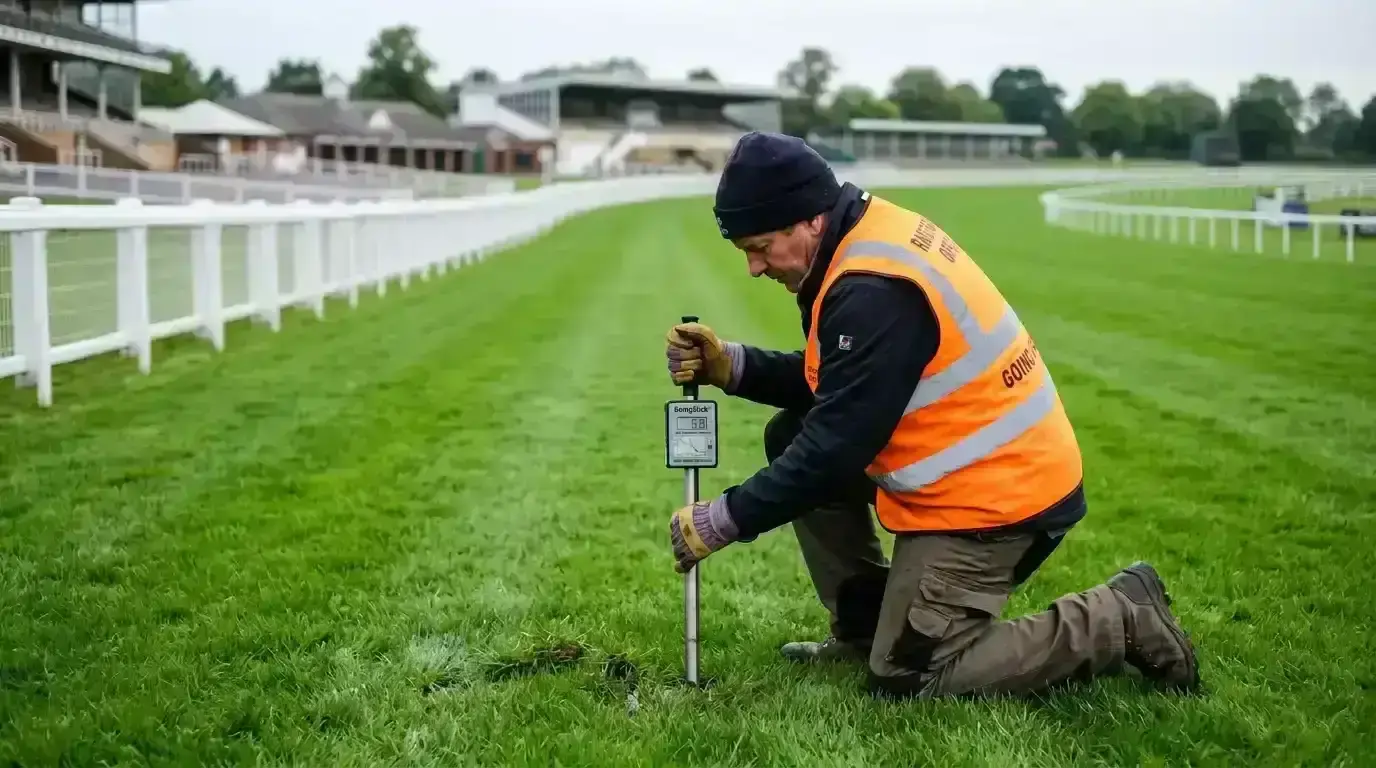
UK racecourses use a going scale that runs from hard (extremely rare and usually deemed unsafe for racing) through firm, good to firm, good, good to soft, soft, and heavy. Jump courses add the term “yielding,” which sits between good and soft and is more common in Ireland than Britain. Each description corresponds to a specific range of moisture in the ground, measured in the modern era by a GoingStick — a penetrometer device inserted into the turf that gives a numerical reading of how much resistance the ground offers.
A GoingStick reading above 10 typically corresponds to good to firm or firmer. Between 6 and 10 is the good range. Below 6 indicates soft or heavy ground. The readings are taken at multiple points around the course, and the official going description is the clerk of the course’s assessment based on those readings, supplemented by walking the track and accounting for forecast weather.
The difference between adjacent descriptions — say, good to firm and good — might seem trivial. It isn’t. For a flat horse with a light, efficient action that skims over the surface, the shift from good to firm to good can add measurable lengths to its race time. For a heavyweight National Hunt horse with big, round joints that grip into the turf, good to soft is preferable to good because the give in the ground cushions the impact of jumping and allows a more sustainable gallop.
The critical thing to understand is that going descriptions are not standardised across courses. “Good to soft” at Cheltenham — a well-drained track on the side of a hill — is a meaningfully different surface from “good to soft” at Wetherby or Fontwell. Experienced bettors learn the idiosyncrasies of individual courses and adjust their expectations accordingly.
How Going Conditions Alter Speed, Stamina, and Running Style
Soft or heavy ground slows the pace of a race and increases the stamina demands. Horses that rely on speed — a sharp turn of foot over the final furlong — are disadvantaged on soft ground because the finishing sprint they depend on is blunted. Front-runners and prominent racers tend to do better in testing conditions because the energy cost of accelerating through soft ground is higher than maintaining a steady pace.
Average field sizes on UK flat racing have dropped to 8.90 runners, while jumps fields average 7.84. BHA Director of Racing Richard Wayman noted that there was much to be pleased about in 2025, with major meetings and races performing strongly — but the smaller average fields mean that going conditions have a proportionately larger effect on results, because fewer runners means less pace variation and more predictable race dynamics.
On fast ground — good to firm or firmer — speed becomes the dominant factor. Quick-actioned horses with a ground-covering stride excel. Stamina is less of an issue because the energy cost per stride is lower on a firm surface. The finishing kick that soft ground blunts is fully available on fast ground, which favours horses that settle behind the pace and produce a strong late run.
For jump racing, the going influences not just the galloping but the jumping. Soft ground makes the take-off area in front of fences less predictable, which increases the risk of jumping errors. Horses that are bold, accurate jumpers handle testing ground better than those with a tendency to be flat or careless at their obstacles. On quick ground, the firmer take-off allows more precise jumping, which suits athletic horses that stand off their fences.
Using Going Data as a Betting Filter
Every horse’s form guide shows its record on different going descriptions, and this is one of the most underused filters in the average bettor’s toolkit. The approach is straightforward: before assessing a horse’s overall form, check its record on the going expected for the race in question. A horse with four wins from six starts on good to soft and zero wins from five starts on good to firm is telling you something — and if the ground has dried out since declarations, that horse’s chance has materially diminished regardless of what the rest of the form says.
I apply going preferences as a binary filter first, then a weighting second. If a horse has never encountered the going conditions expected for the race and there’s no pedigree evidence to suggest it would handle them, I remove it from my shortlist entirely. If it has limited experience on the going but a reasonable theoretical chance of coping — perhaps its sire’s progeny have a good record on soft ground, or it’s shown ability on similar surfaces — I downgrade rather than eliminate, reducing its prominence in my staking plan.
The most profitable going-related angle I’ve found is identifying horses whose market price hasn’t adjusted for a change of ground. A horse that opened at 5/1 in the morning on good ground might still be 5/1 or even shorter when the going changes to good to soft after rain — but if its soft-ground record is poor, the true price should be closer to 8/1 or 10/1. That mismatch between the market’s stale assessment and the updated reality is pure value.
Conversely, a horse that was 10/1 because its recent form on good ground was moderate might be a 6/1 shot on its preferred soft ground, yet the market sometimes stays at 10/1 because casual bettors don’t check ground records. These situations are where going analysis generates its best returns — not as a standalone strategy, but as a filter that sharpens every other aspect of your form work.