
Managing Exchange Liability When Laying Market Leaders
The first time I laid a favourite, it felt unnatural. Years of conditioning had taught me that betting meant backing a horse to win. Betting against one — actively wanting the market leader to lose — went against every instinct. Then the favourite got swallowed up in the final furlong, my lay bet settled at a profit, and I understood why exchange traders have been doing this for two decades.
UK favourites win approximately 34.4% of all races. Turn that around and it means favourites lose nearly two out of every three contests. That’s not a flaw in the market — it’s a structural feature. The public overloads money onto the horse they perceive as most likely to win, which compresses its odds below fair value. When that horse loses — which it does the majority of the time — the exchange layer collects.
Laying every favourite blindly is not a strategy. The commission and the occasional short-priced winner that costs you multiples of your stake will grind your bankroll down. But selectively laying weak favourites in the right race types, with proper liability management, is one of the most consistent edges available on UK betting exchanges.
Favourite Win Rates by Race Type: Handicaps, Non-Handicaps, and Jumps
Not all favourites are created equal, and the data makes this strikingly clear. The overall 34.4% win rate is an average that masks enormous variation depending on the type of race.
In non-handicap races — conditions stakes, maiden races, novice events — favourites win roughly 39% of the time. These races have smaller fields, clearer form lines, and less randomness. The market tends to identify the best horse accurately, and that horse delivers more often. Laying favourites in non-handicaps is fighting against the strongest part of the market’s predictive ability.
Handicaps tell a completely different story. The handicapper’s job is to equalise the field by allocating weight according to ability, which compresses the true probability differences between runners. In UK handicaps, favourites win just 25.7% of the time. That means three out of four handicap favourites lose. The implied probability on a typical handicap favourite at 3/1 is 25%, which aligns almost exactly with the actual win rate — but many handicap favourites are sent off at shorter prices than 3/1, making them overlaid by the market.
Jump racing sits between the two extremes. Favourites win approximately 30% of all steeplechases and hurdle races, with the additional variable of jumping errors introducing a layer of unpredictability that flat racing doesn’t have. A favourite that’s clearly the best horse on form can still fall at the third fence. Odds-on favourites on the flat turf win around 59% — impressive until you realise that laying them at odds-on means your liability relative to your profit is heavily skewed against you. A 1/2 shot that wins costs you twice your potential gain.
The sweet spot for laying sits in competitive handicaps — ideally large-field handicaps on the flat or over jumps where the favourite is trading between 5/2 and 7/2. At those odds, the liability is manageable, the win rate is low, and the market routinely overprices the perceived leader.
Spotting a Weak Favourite: Five Warning Signs
I keep a checklist that I run through before laying any favourite. Over the years I’ve found five signals that reliably indicate a favourite is vulnerable — not guaranteed to lose, but significantly more likely to get beaten than their odds suggest.
The first is a favourite stepping up sharply in class. A horse that won a Class 5 handicap last time and is now favourite for a Class 3 off an adjusted mark has been backed on reputation rather than evidence. The ratings may have caught up, but the market hasn’t always priced in the stiffer opposition.
Second, look for favourites returning from a long absence. Any horse absent for 90 days or more carries fitness uncertainty. Trainers bring horses back to race fitness through gallops and exercise, but there’s no substitute for competitive sharpness. The market often favours a well-known name returning from a break, overlooking the fact that the horse needs the run.
Third, a ground shift that doesn’t suit. If the going has changed from good to soft overnight and the favourite’s entire form is on fast ground, they’re vulnerable regardless of what the odds say. Ground preference is one of the most reliable predictive factors in UK racing, and the market is surprisingly slow to adjust.
Fourth, a jockey booking that signals trainer doubt. When a leading stable books a claiming jockey — an apprentice or conditional rider claiming a weight allowance — on their market leader, it often means the trainer values the weight reduction over having an experienced hand in the saddle. That’s a signal of marginal confidence, not a ringing endorsement.
Fifth, a favourite whose price has drifted on the exchange in the final 15 minutes before the race. As HBLB Chief Executive Alan Delmonte noted in the context of shifting market dynamics, bookmakers’ operating margins have fluctuated as turnover patterns change — and the sharpest market intelligence often surfaces late. When informed money moves away from the favourite in the minutes before the off, there’s usually a reason — even if that reason isn’t visible to the casual punter watching on a screen.
Managing Lay Liability: How Not to Blow Your Bankroll
Laying is seductive because winners feel effortless — the horse loses and you collect. The danger is that one unexpected winner at the wrong odds can wipe out weeks of patient, profitable laying.
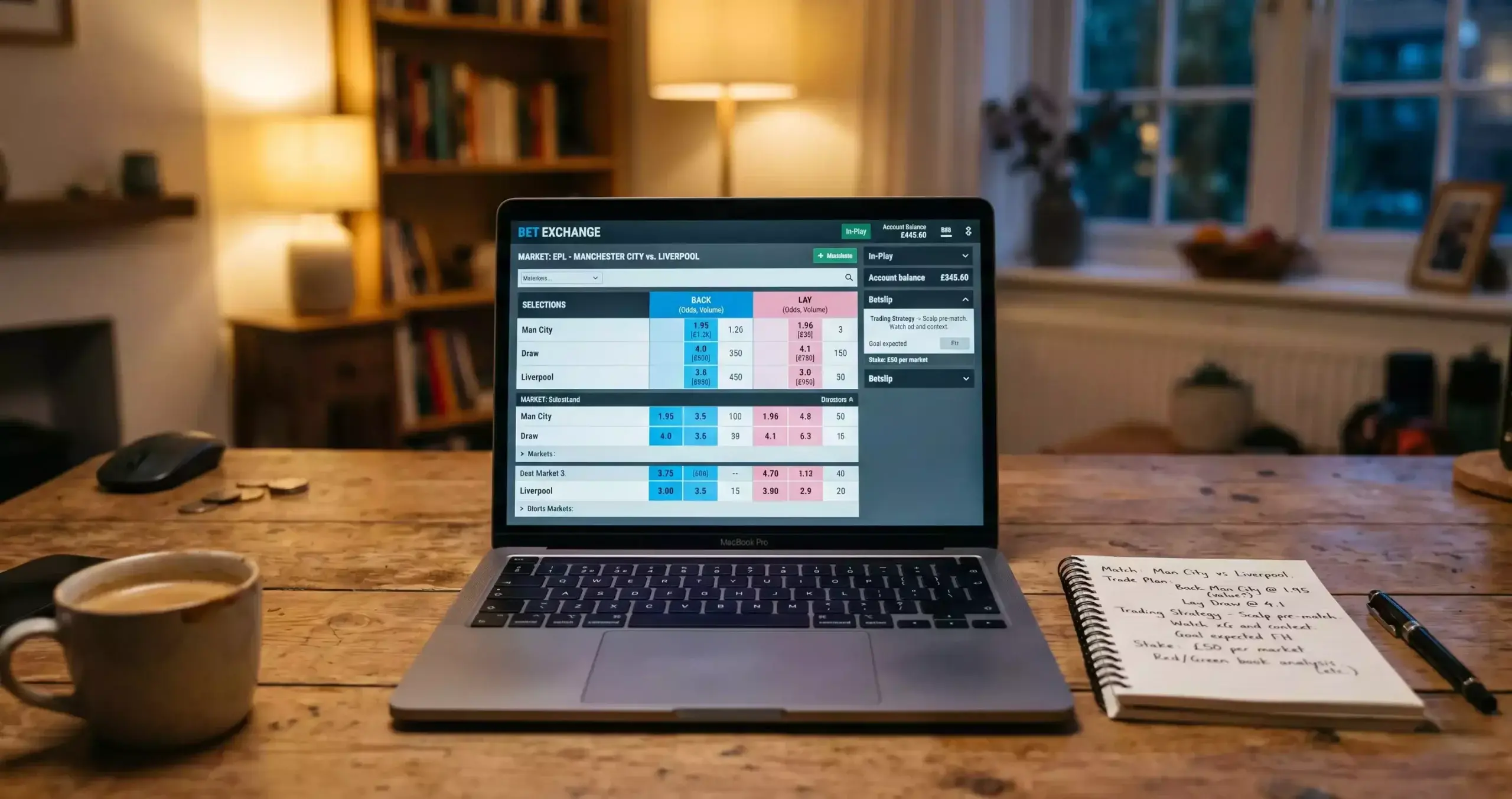
Your liability on a lay bet is calculated as: (lay odds – 1) multiplied by your stake. If you lay a horse at 4.0 for 10 pounds, your liability is 30 pounds — that’s what you lose if the horse wins. If it loses, you keep the 10 pounds minus exchange commission.
I never let my liability on a single lay bet exceed 5% of my exchange bankroll. On a 1,000-pound exchange balance, that means my maximum liability per lay is 50 pounds. At lay odds of 4.0, that translates to a maximum stake of about 16.67 pounds. At lay odds of 6.0, the stake drops to 10 pounds. This scaling is automatic if you think in terms of liability rather than stake — the higher the odds, the smaller the stake, because the potential loss is greater.
The other critical discipline is race selection. I lay favourites in no more than two or three races per day, and only after running through the five warning signs above. Mass-laying — putting up lay bets on every favourite across an afternoon’s card — produces the kind of variance that breaks bankrolls. One Saturday at Ascot with three or four winning favourites across six races can cost you a month’s profit in an afternoon.
Track everything. Record the race, the horse, your lay odds, your liability, and your reasoning. After 200 lays, you’ll have a dataset that tells you exactly which race types, which odds ranges, and which conditions produce your most profitable results. Without that data, you’re guessing — and guessing is what the people on the other side of your lay bets are doing.