
Targeting Trainer Patterns in Sharp Flat Racing Markets
Royal Ascot occupies a peculiar position in the betting calendar. It’s the most prestigious flat meeting in Britain, broadcast globally, attended by royalty, and covered in more column inches than any other fixture outside of the Grand National. It also produces some of the sharpest, most efficiently priced betting markets of the entire flat season — and that makes finding value harder than at almost any other meeting.
British racecourse attendance passed the 5.031 million mark in 2025, the highest since 2019, and Royal Ascot’s five-day meeting is one of the biggest contributors to that total. The volume of professional and public money flowing into Royal Ascot markets means that prices on the leading contenders are typically tight and accurate. The value, when it exists, tends to sit in specific pockets: the big-field handicaps, the draw-influenced sprints, and the trainers whose Ascot records deviate meaningfully from their overall strike rates.
My Royal Ascot approach is built around three pillars: pattern-race form analysis, draw data for the straight course, and trainer statistics that reveal which yards consistently overperform at the meeting.
Group-Race Form: Why Pattern Results Predict Ascot Winners
Royal Ascot’s Group 1 and Group 2 races attract the best horses in training, and the form lines between these races are unusually reliable. A horse that has contested — not necessarily won — a Group 1 in the weeks before Ascot arrives with a level of form that is both well established and thoroughly analysed. The market knows about these horses, which means the value rarely lies in backing the obvious form pick at a short price.
Where pattern-race form becomes genuinely useful is in identifying horses that are moving through the grades. Total prize money in British racing hit a record £194.7 million in 2025, and the concentration of that money at the top level incentivises trainers to target progressive horses at Royal Ascot even if they haven’t yet achieved a Group 1 win. A horse that won a Group 3 in May and is stepping up to Group 1 company at Ascot might be priced at 12/1 or longer — and if the form analysis suggests it’s still improving, that price can represent excellent value.
I pay particular attention to two-year-old races at Royal Ascot: the Coventry Stakes, the Queen Mary, and the Norfolk. These races often feature well-bred horses with limited form but strong trial performances, and the market’s assessment of them is less reliable than in races featuring proven older horses. The combination of small sample sizes, trainer reputation, and pedigree analysis makes the two-year-old races at Royal Ascot some of the most fertile ground for finding mispriced runners.
Continental form is increasingly relevant at Royal Ascot. French and Irish raiders have won Group 1 races at the meeting in multiple recent years, and UK-based bettors often undervalue foreign form because they’re less familiar with it. A horse with a strong performance in a French Group 1 at Longchamp or a Group 2 at the Curragh may arrive at Ascot with form that UK punters haven’t fully absorbed — and the price reflects that informational gap.
Ascot’s Straight Course vs Round Course: Draw Implications
Ascot has two distinct track configurations, and the draw implications are different for each.
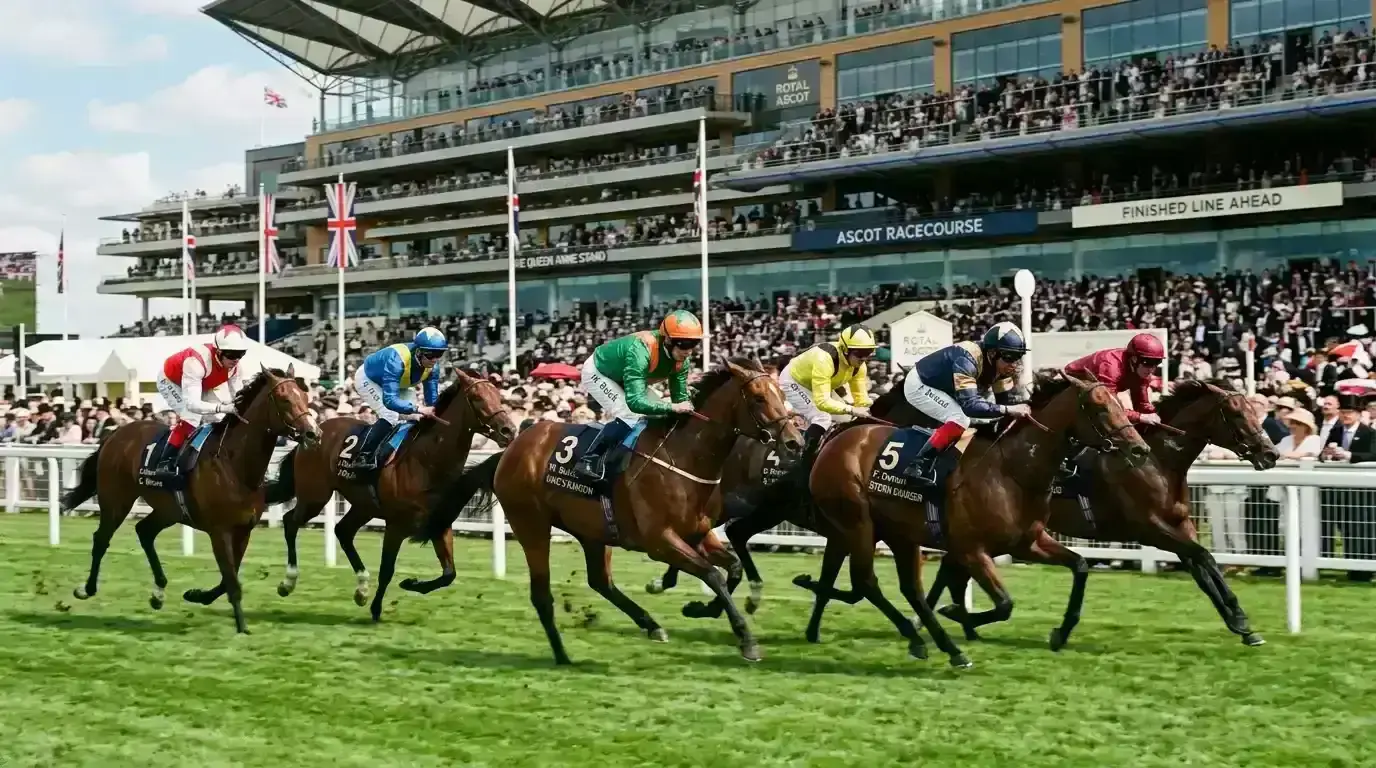
The straight course, used for races up to a mile, runs from the five-furlong start directly to the winning post without any bends. In theory, a straight course should produce no draw bias because every horse covers the same distance. In practice, going conditions create temporary biases. When the ground is soft, the rail on the stands’ side often provides better footing because it receives less traffic. When the ground is firm, the difference is negligible. Wind direction can also push an advantage to one side of the course, though this is harder to predict in advance.
Over five and six furlongs on the straight course in larger fields, the market sometimes splits — runners gravitate to one side or the other, and the group on the “right” side has a collective advantage. Watching the first few sprints on the card can reveal which part of the track is riding fastest before the feature races later in the day. This is real-time intelligence that pre-race analysis alone cannot provide.
The round course, used for races of a mile and a quarter and beyond, is a right-handed, galloping track with a sweeping home turn. Draw bias on the round course is minimal because the distance involved gives wide-drawn horses time to settle into position. The key factor on the round course is pace: the uphill finish demands stamina, and horses that race prominently or are able to quicken from midfield have a structural advantage over hold-up horses that rely on a strong finishing sprint alone.
Trainer Statistics at Royal Ascot: Who Performs Above Expectation?
Certain trainers have Royal Ascot records that far exceed what their overall strike rates would predict. This isn’t random — it reflects systematic targeting, superior horse preparation, and sometimes a genuine understanding of what Ascot’s unique track demands require.
Aidan O’Brien’s Ballydoyle operation brings the largest and most meticulously targeted team each year, and his Group 1 record at the meeting speaks for itself. But backing O’Brien horses blindly is not a strategy — his runners often go off at prohibitively short prices, and the value lies in identifying which of his multiple entries in the same race represents the yard’s primary hope versus which are pacemakers or secondary options.
Brant Dunshea, then Acting Chief Executive of the BHA, noted that gambling regulations should be balanced and proportionate, allowing those betting safely to do so without interruption — a sentiment that reflects the broader industry context in which Royal Ascot’s betting markets operate. The meeting generates enormous regulated turnover, and the quality of the markets benefits from the participation of informed, serious bettors alongside the casual public.
Among British trainers, yards with a history of Ascot course winners — rather than just overall winners — are worth tracking. Some trainers have an excellent record with horses that specifically suit Ascot’s uphill finish and stiff track: strong-travelling types with stamina to sustain their effort. Others have a disproportionately good record in the handicaps, where the combination of race selection and handicap exploitation can produce value at bigger prices than the feature races offer.
The practical approach is to compile trainer records specifically at Ascot over the past three to five years, filtered by race type (Group race vs handicap), distance, and ground. A trainer with a 25% strike rate at Ascot handicaps against a 12% overall handicap strike rate is telling you something the market may not fully reflect.